
GL or RL: What It Means and How to Decide on Your QC Photos
By Chen Hong Jie · Updated · 5 min · Español · Français · Italiano · Français (CA)
Quick answer
GL (green light) means approving an item so it can ship; RL (red light) means rejecting it and asking for an exchange or return. Give an RL if the size, colour or model is wrong or there’s a visible defect such as a stain, tear or broken zipper. Give a GL if there are only minor flaws you can fix at home, and ask for extra photos when something important isn’t visible.
GL stands for green light: you approve the item and it’s ready to go in your parcel. RL stands for red light: you reject it and ask your agent for an exchange or a return to the seller. The rule of thumb is simple — RL anything that’s wrong (size, colour, model) or visibly damaged, GL anything with only small flaws you can fix yourself, and ask for more photos when you can’t tell. The rest of this guide turns that rule into a decision you can make in under a minute.
The definitions
- GL (green light): the item looks right. You approve it and it waits in the warehouse until you create your shipment.
- RL (red light): the item has a problem. You ask the agent to contact the seller for an exchange or a refund.
You’ll see both terms everywhere: on agent dashboards, in Reddit threads and on Discord servers where people post their QC photos and ask “GL or RL?”. For other terms such as in hand, haul or W2C, check the QC glossary.
The quick decision rule
| If you see… | Decision |
|---|---|
| Wrong size, colour or model | RL |
| Visible stain, hole or tear | RL |
| Broken zipper, strap or part | RL |
| Measurements far off the chart (more than 3–4 cm across the chest) | RL or size exchange |
| Two sneakers that clearly don’t match | RL |
| Slightly crooked seams, print a little off-centre | Your call |
| Loose threads, a little glue, packing creases | GL |
| An important area isn’t visible | Ask for extra photos first |
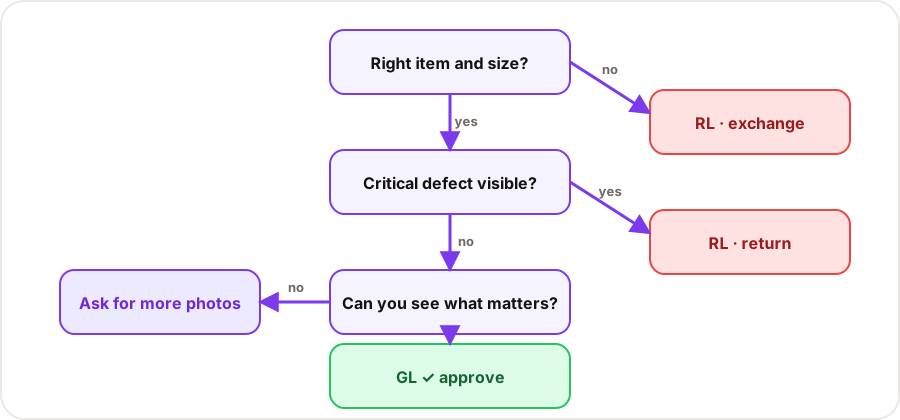
The flowchart above follows the same logic: identity first, then critical defects, then whether you can actually see everything that matters. Only when all three are clear do you get to GL.
Three questions that settle most cases
1. Would I notice it when wearing or using the item?
A thread on the inside seam: no. A pen-sized mark on the front of a white T-shirt: yes. If you’d notice it every time you use the item, it’s worth an RL.
2. Can I fix it in under ten minutes?
Trimming threads, rubbing off a glue spot or ironing out creases — that’s a GL. Re-sewing a shoulder seam or replacing a zipper is not a home job for most people. See our list of minor defects you can fix at home.
3. Is it the seller’s mistake?
If you got a different size or colour from what you ordered, that’s on the seller. An RL is almost always worth it here, and the seller often pays the return shipping inside China.
Think about the cost of waiting
An RL is not free, even when the seller pays. It usually means:
- Return shipping to the seller (a few days).
- Waiting for the replacement to arrive at the warehouse.
- A new round of QC photos — which may show a new problem.
| Situation | GL makes sense if… | RL makes sense if… |
|---|---|---|
| You’re in a hurry (gift, season starting) | The flaw is minor and fixable | The flaw is critical |
| The item is cheap | The flaw is cosmetic | The item is unusable |
| It’s a popular item with stock | — | Getting a better unit is likely |
| The seller has run out of stock | You can live with it | You prefer a refund |
If the defect is minor and you want your parcel soon, a GL can be the reasonable choice. If the defect will bother you every day, the extra week is worth it.
What to do after you decide
- After a GL: the item stays at the warehouse until you build your parcel. Before shipping, check that every item in your order has been reviewed.
- After an RL: use the “Return a defective item” or “Exchange for another size” template in the agent message generator, then follow our guide on returns and exchanges with your agent.
For a guided verdict, open the checklist for your product: you mark each point and it suggests GL, RL or “ask for more photos”. The suggestion is just that — you always have the final say.
GL or RL by product type
The same rule applies to everything, but each category has its own usual suspects. Here’s where buyers most often hesitate, and what usually tips the balance.
| Product | Usually GL | Usually RL |
|---|---|---|
| T-shirts and hoodies | A few loose threads, packing creases | Stain on the front, wrong size label, print clearly crooked |
| Jackets and coats | Slightly uneven quilting lines | Zipper that won’t close, torn lining, flat spots in a puffer |
| Pants and jeans | Long threads at the hem | Waist more than 2–3 cm off the chart, legs of different lengths |
| Sneakers | Small glue spots along the sole | Two different sizes, toe boxes clearly different, big glue stains on light leather |
| Bags | Light creases from folding | Handle stitching coming loose, scratched or rusty hardware |
| Electronics | Scuffed packaging | Doesn’t power on, wrong plug or voltage, missing charger |
A few category-specific notes:
- Winter gear deserves extra care. A coat you’ll wear every day from November to April needs a zipper and seams that hold up in the cold. Be stricter there than on a summer T-shirt.
- Sneakers are judged as a pair. One shoe that looks perfect doesn’t help if the other one has a different heel shape. Always look at photos where both shoes are side by side.
- Electronics need proof it works. A photo of the box is not enough to give a GL. Ask for a short video of the item powered on.
Each product checklist lists these points in order of severity, so a critical failure pushes you to RL and a minor one doesn’t. If your item isn’t in the list, use the closest category and apply the three questions above.
Common mistakes
- Approving without zooming in. Small stains are invisible on a phone thumbnail.
- Giving an RL for packing creases. They disappear after one wash.
- Waiting too long. The seller’s return window keeps ticking while the item sits in the warehouse.
- Not checking both shoes. Mismatched sizes or shapes in one pair happen more often than you’d think.
If you’re still unsure after all that, ask for one more photo. It costs little and turns a guess into a decision.
Frequently asked questions
+What does GL mean on Reddit or Discord?
Green light: the item looks fine and can be approved. People post their QC photos and ask “GL or RL?” to get a second opinion before they decide.
+Does giving an RL cost money?
Usually you pay the domestic return shipping to the seller inside China. If the mistake is the seller’s (wrong size or colour), many sellers cover it — ask in your message.
+Can I GL an item with a small defect?
Yes. Lots of buyers accept loose threads or a dab of glue because they’re easy to fix at home and it avoids waiting for an exchange.
+Is there a time limit for giving an RL?
Yes. Sellers on Chinese platforms usually accept returns only for a few days after the item reaches the warehouse, so decide quickly.